The Books
The driving force behind Peter Savge Books lies in a deep commitment to telling stories grounded in truth—where fiction meets the raw edge of reality. Inspired by real events and lived experiences, each book explores the complex and often harrowing journey of humanity during times of war. These are stories of unimaginable courage, quiet resilience, and the enduring spirit of those caught in the chaos of conflict. They reveal both the best and the most horrific sides of human nature—compassion and cruelty, hope and despair, survival and sacrifice. Peter Savge writes not to sensationalise, but to bear witness, honour the forgotten, and remind readers of the extraordinary strength found in ordinary people. His work is a powerful tribute to those who live through history’s darkest moments, capturing their voices and sharing their truths with the world—so that we may remember, reflect, and never lose sight of our shared humanity.
Ukraine, the Good, Bad and the Ugly. From the Bucha massacre, Liberation of Kherson to the fall of Bakhmut.
Book.1 Ukraine: The Good, Bad and the Ugly. From the Bucha massacre, Liberation of Kherson to the fall of Bakhmut. Join the journey of a battle-hardened military veteran turned chaplain as he embarks on a mission to war-ravaged Ukraine. His task? To pioneer innovative approaches for providing aid and forging fresh connections amidst the chaos of conflict. Experience the triumphs of his mission alongside the harrowing ordeals he faces on the front lines. Unearth the real struggles confronted by humanitarian workers and non-governmental organisations as they tirelessly strive to deliver essential assistance to the most at-risk populations.
Ukraine, Transforming, Hobby Drones for Warfare.
Book.2.Ukraine: Transforming Hobby Drones for Warfare. Drones, artificial intelligence, and machine learning have fundamentally redefined modern warfare, representing the most profound shift in conflict since the introduction of gunpowder. During Peter Savage’s early time in Ukraine, unmanned systems were already influencing the battlefield, yet they remained heavily reliant on human pilots. Autonomy and AI-driven decision-making were widely regarded as future capabilities rather than tools ready for real-world combat.
Over the following three years of sustained work in and around Ukraine, that perception changed dramatically. Technologies once confined to theory rapidly became operational realities. Artificial intelligence began to play a direct and measurable role in drone warfare, enabling AI-assisted navigation in GPS-denied environments and machine-learning systems capable of adapting flight behaviour under intense electronic warfare pressure. Target recognition, mission planning, and in-flight decision-making increasingly shifted toward autonomous systems. This rapid progression from concept to capability unfolded in real time, transforming speculative ideas into lived battlefield experience.
Drones, artificial intelligence, and autonomous systems reshaping modern warfare in real time on today’s battlefields.
.
[Home] [The Author] [Books] [Contact] [The Blog] [Gallery]
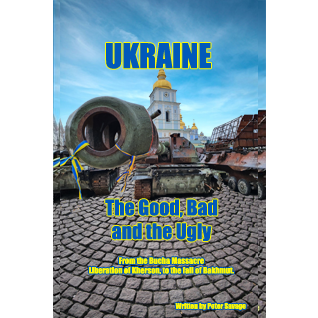
Ukraine, The Good bad and the Ugly
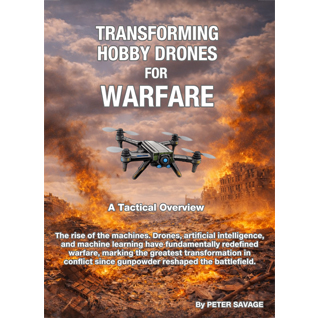
Hobby Drones for Warfare

Part Time Soldier, Full Time Warrior
Hobby Drones, in Warfare
In the early days of the 2022 full Russian invasion of Ukraine, during the initial offensive aimed at capturing Kyiv, Peter Savage travelled to the region in his capacity as a Chaplain. His mission was to assist in coordinating humanitarian aid from Australia and the United Kingdom for severely affected communities and those critically wounded by the conflict.
What he encountered was far beyond what most could imagine. Among the most harrowing experiences was his visit to Bucha, a town that had recently endured a horrific massacre during the battle in February. There, Peter witnessed the aftermath of atrocities committed against civilians—families, children, and infants—many of whom had sought refuge in the basements of residential buildings. Victims had been found handcuffed, executed with shots to the head, and their bodies burned in what appeared to be an attempt to conceal evidence of war crimes.
It is difficult to convey the emotional weight of what Peter experienced. Among the most haunting images were those of mothers cradling their children in death, their bodies intertwined—both shot and burned—preserved only as charred reminders of unimaginable suffering.
Motivated by what he had seen, Peter wrote a short account for publication and remained in Ukraine, continuing his work within the aid community. He formed a close connection with St Sophia Cathedral in Kyiv and worked to support both spiritual and material relief efforts. However, his background in electronics, microprocessors, and military service—including over a decade in the Royal Australian Air Force—soon proved invaluable in unexpected ways.
As Peter travelled deeper into the conflict zones, including Kherson, Bakhmut, and the Donbas region, he began observing a significant shift in how civilians and soldiers were adapting to the evolving nature of warfare. In particular, he noted the innovative and widespread use of hobby drones—initially designed for recreation—repurposed for frontline military applications such as reconnaissance and improvised bombing missions using hand grenades.
Though his primary role was humanitarian, Peter paid close attention to the grassroots ingenuity around him. The repeated requests he heard from Ukrainian fighters and volunteers were not only for food, medicine, and protective gear, but also for drones, spare parts, and 3D printers. These tools were urgently needed to modify and manufacture components for the ongoing adaptation of consumer drones into tactical battlefield assets.
Through extensive note-taking, interviews, and firsthand observation, Peter developed an in-depth understanding of these grassroots efforts and the emerging role of artificial intelligence in a new and complex form of warfare. He had the opportunity to meet with several battalion commanders who shared their insights into how drones had rapidly become indispensable tools in this evolving conflict.
Shipments of hobbyist equipment—ranging from balsa wood fixed-wing aircraft kits to rotary drone motors and 3D-printed components—were now flowing into Ukraine from suppliers across Europe. What was unfolding before Peter’s eyes was not just a response to necessity, but the birth of a radically new mode of warfare: one in which civilian-grade technologies and off-the-shelf components were being repurposed at scale for lethal effectiveness on the modern battlefield.
This book presents a window into Peter’s journey—what he saw, what he learned, and the profound ethical questions that arise from the militarisation of civilian technology in a time of total war.
Part Time Soldier, Full Time Warrior
Part Timne Soldier, Full Time Warrior. A boys journey that transforms him into a soldier through discipline, training, and a sense of duty. The crucible of military life instills resilience, teamwork, and adaptability, shaping him into a defender of principles. The journey involves sacrifice, courage, and a commitment to safeguarding others, forging a warrior from youthful potential into a weapon of war.